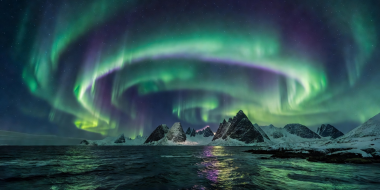
Tromsø & Kvaløya
Known as the primary gateway, coastal Tromsø offers easy access to Sommarøy on the open Atlantic, while the inland valleys of Kattfjordeidet provide mountain shields against low cloud banks.
Seeing the Northern Lights is fundamentally an exercise in solar physics and local geography, rather than luck or commercial magic.
Northern Norway sits directly underneath the statistical center of the Auroral Oval (between 65°N and 72°N latitude). This means even quiet geomagnetic conditions (Kp 1 to Kp 2) frequently produce luminous curtains visible from ground level, provided the sky is free of low-altitude maritime clouds.
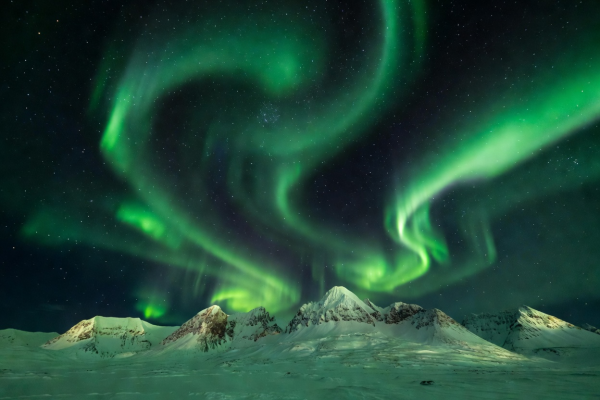
Because coastal moisture often traps cloud cover against the outer mountains, choosing observation locations requires recognizing regional rain-shadow barriers.
Known as the primary gateway, coastal Tromsø offers easy access to Sommarøy on the open Atlantic, while the inland valleys of Kattfjordeidet provide mountain shields against low cloud banks.
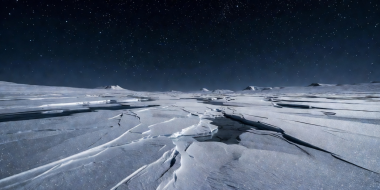
Protected from direct ocean fronts, Alta possesses a continental microclimate. The expansive Finnmarksvidda plateau provides stable, crisp winter air with significantly fewer cloud-obscured nights.
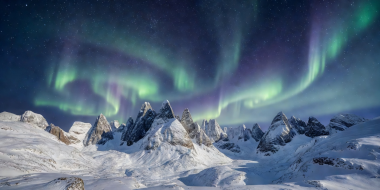
Skibotn on the Lyngen Fjord is famous for its micro-climatic rain shadow. When coastal storms shroud Tromsø, Skibotn frequently maintains a clear, dry sky window due to the barrier of the Lyngen Alps.
The intensity, color spectrum, and altitude of the Northern Lights reflect specific atmospheric reactions:
Modern aurora chasers often fixate solely on the planetary Kp index (scale 0 to 9). However, inside Northern Norway's auroral belt, a Kp of 1 or 2 is sufficient for overhead activity. The far more critical metric is the interplanetary magnetic field (IMF) parameter known as Bz.
When Bz turns negative (pointing southward), it connects with Earth’s northward-facing magnetic shield, opening a direct funnel for solar plasma to ignite dynamic substorms.
| Common Assumption | Field Reality | Expedition Adjustment |
|---|---|---|
| "It must be bitterly freezing outside for auroras to appear." | Temperature at ground level has zero bearing on magnetospheric activity 100 km above. Cold nights are simply more likely to be clear. | Seek high barometric pressure systems regardless of actual ground chill. |
| "A full moon completely ruins Northern Lights visibility." | While moonlight dims faint auroral haze, moderate displays stand out crisply against illuminated snow peaks, providing superior photographic context. | Incorporate moonlit foreground mountains rather than avoiding lunar phases. |
| "Sightings can be guaranteed with a tour." | Solar activity and tropospheric cloud formations are fundamentally uncontrollable natural events. | Plan for multi-night windows between October and March to accommodate weather cycles. |